
racing seats
Racing Seats: The Complete Guide to Bucket, Sport & FIA Seats
Looking for the perfect racing seats? Our complete guide breaks down everything you need to know about bucket, sport, and FIA-approved seats to upgrade your ride.
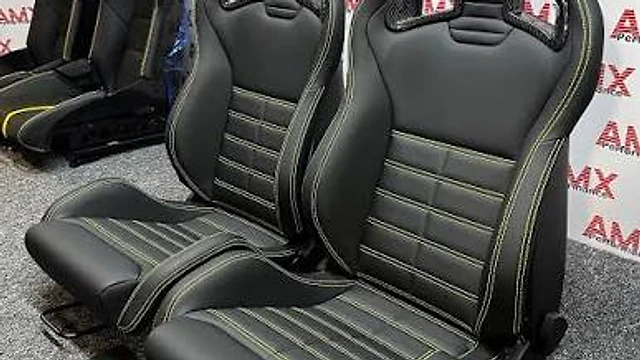
What are racing seats?
At their core, racing seats are purpose-built safety components engineered to secure the driver within the cockpit during high-G maneuvers. Unlike standard automotive seating, which prioritizes long-term comfort and convenience features like power adjustment or heating, a true bucket seat is a structural element designed for occupant retention, ergonomic support, and chassis feedback.
The Anatomy of Performance
Modern performance seats are defined by their construction and safety standards. To provide maximum rigidity with minimal mass, manufacturers often utilize:
- Carbon Fiber: The industry standard for lightweight, high-tensile structural shells.
- Aramid/Fiberglass: Cost-effective alternatives that provide high impact resistance.
- Premium Finishes: Hand-stitched Nappa leather or Alcantara for grip, wear resistance, and interior integration.
Functionally, these seats feature deep side bolsters and integrated harness routing, allowing for the use of multi-point racing harnesses. This design prevents lateral movement, ensuring the driver maintains a precise connection to the vehicle’s dynamic behavior. While professional racing seats often adhere to stringent FIA (Fédération Internationale de l'Automobile) 8855-1999 or 8862-2009 standards for impact energy management, they involve distinct trade-offs. The fixed-back nature of an FIA-homologated shell offers superior safety and weight savings, yet it restricts seat recline, necessitating careful measurement of shoulder width, torso length, and hip dimensions to ensure proper fitment. Ultimately, choosing the right seat is a balancing act between structural safety, weight-to-stiffness ratios, and the specific requirements of the track or road environment.
Carbon fiber vs fiberglass shells
When selecting professional-grade racing seats, the structural material of the shell is the most critical factor for both driver safety and performance. The choice between fiberglass and carbon fiber fundamentally alters the chassis-to-driver connection.
Fiberglass: The Industry Standard
Fiberglass shells are manufactured by layering glass-reinforced plastic resin into a mold. They remain the most popular choice for club-level racing seats due to their cost-effectiveness and durability. While fiberglass offers excellent rigidity, it carries a weight penalty compared to composite alternatives. Because the material is less stiff per square millimeter, shells must be thicker to maintain structural integrity, which slightly increases the overall dimensions and seat mass.
Carbon Fiber: The Performance Benchmark
For elite motorsport applications, carbon fiber is the gold standard. Utilizing a weave of carbon filaments cured under high pressure, these shells achieve an exceptional strength-to-weight ratio. By incorporating carbon fiber, manufacturers can produce thinner walls without sacrificing crash safety or chassis stiffness. Key benefits include:
- Weight Reduction: Carbon shells can be up to 40% lighter than equivalent fiberglass versions, crucial for center-of-gravity optimization.
- Driver Feedback: The increased stiffness ensures that every vibration and mechanical detail from the vehicle is transmitted directly to the driver.
- Ergonomic Precision: Due to superior material density, these seats maintain complex geometries that provide optimal torso support under high-G cornering.
Ultimately, fiberglass is ideal for endurance and track-day use, while carbon fiber is engineered for those who demand maximum performance and weight savings in their racing seats.
FIA-rated seats and homologation
When selecting racing seats for competitive motorsport, safety is non-negotiable. FIA-rated seats undergo rigorous testing protocols, specifically under the FIA 8855-1999 or 8862-2009 standards, ensuring they can withstand extreme G-forces and structural impacts. Unlike standard aftermarket options, these units are engineered to maintain structural integrity during a crash, often utilizing advanced resin-transfer molded carbon fiber to maximize the strength-to-weight ratio.
Understanding Homologation
Homologation is the process by which a sanctioning body certifies that a seat meets specific safety benchmarks. The 8862-2009 standard, in particular, requires testing against significantly higher energy loads than the baseline 8855-1999 standard. Key considerations for drivers include:
- Expiration Dates: FIA-homologated seats have a mandatory validity period, typically five years from the date of manufacture, to account for material fatigue.
- Mounting Requirements: True competition shells require specific side-mount brackets that comply with FIA spatial dimensions to ensure the seat remains anchored during high-speed kinetic events.
- Head Restraint Systems: High-end carbon fiber variants often integrate halo-style head restraints, which are critical for limiting lateral head movement and preventing whiplash in professional touring car environments.
While an FIA-rated seat offers unparalleled protection, it often requires a trade-off in comfort. These racing seats are designed for rigid driver positioning, which, while ideal for track precision, can be unforgiving for daily driving. For those competing at the highest levels, choosing a seat that matches your specific chassis geometry and harness system is vital for safety compliance.
Bucket seats vs sport seats
When selecting racing seats, the distinction between bucket and sport configurations comes down to the balance between track-focused rigidity and daily drivability. Understanding these structural differences is vital for performance enthusiasts.
Bucket Seats: Purpose-Built Performance
True bucket seats are engineered for maximum lateral support and weight reduction. Often constructed from high-tensile carbon fiber or fiberglass, these shells are fixed-back, meaning they lack recline functionality to maintain structural integrity under high G-loads. Key technical attributes include:
- Safety Standards: Many are FIA-homologated, designed to integrate with multi-point harnesses and HANS devices.
- Ergonomics: Tight bolster dimensions prioritize body containment over comfort, minimizing driver movement during cornering.
- Weight: Specialized materials like exposed carbon fiber keep unsprung mass minimal.
Sport Seats: The Dual-Purpose Compromise
Sport seats offer a middle ground for street-legal performance vehicles. Unlike rigid buckets, these feature internal metal frames with integrated recline mechanisms and adjustable headrests. While they retain the aesthetic of racing seats, they prioritize long-distance comfort and accessibility.
- Materials: Often finished in premium Nappa leather or Alcantara, focusing on tactile luxury.
- Dimensions: Broader hip and shoulder dimensions accommodate diverse body types for extended periods.
- Compatibility: Designed for standard three-point OEM seatbelt systems, ensuring they remain practical for commuting while offering more bolstering than standard factory chairs.
Choosing between them requires a realistic assessment: if your build spends 90% of its time on the track, the rigid security of a bucket seat is non-negotiable; for road-biased performance, sport seats provide the ideal ergonomic support.
Harness compatibility and harness holes
When selecting professional racing seats, harness compatibility is not merely a convenience feature—it is a critical safety requirement. The pass-through holes located in the seat back, known as harness apertures, are precision-engineered to guide the shoulder straps of a multi-point racing harness. Their primary function is to ensure the harness maintains the correct geometric angle relative to the driver’s shoulders, typically positioned between 0 and 20 degrees downward from the horizontal plane to prevent spinal compression during an impact.
Technical considerations for aperture design
- Geometry and Width: High-end carbon fiber shells utilize widened apertures to accommodate HANS devices and varying driver heights, ensuring straps do not chafe against the seat shell.
- Edge Protection: Premium manufacturers utilize rubberized trim or molded carbon edges to reduce harness webbing abrasion, significantly extending the service life of your safety equipment.
- Structural Integrity: The aperture area is a significant load-bearing point. Bespoke racing seats from AMX Performance integrate additional carbon fiber reinforcement layers around these openings to maintain structural rigidity under extreme deceleration forces.
Avoid the common mistake of selecting a seat based solely on aesthetics; if your shoulder straps pull upward or at an aggressive downward angle, the seat’s geometry is incorrect for your torso length. Proper alignment is vital for the harness to secure the driver firmly against the seat back. When upgrading, always verify that the seat’s apertures align with your chassis-mounted harness bar to maintain the integrity of your restraint system.
Side-mount vs bottom-mount rails
When selecting your performance hardware, understanding the mounting mechanism is critical for both safety and ergonomics. Choosing between side-mount and bottom-mount configurations dictates how your racing seats interface with the chassis, ultimately influencing your center of gravity and safety certification status.
Bottom-Mount Rails
Bottom-mount systems utilize four bolt points located on the base of the seat shell. This design is prevalent in entry-level aftermarket sport seats and OEM replacements. While they offer ease of installation and compatibility with sliding tracks, they often suffer from two major drawbacks:
- Elevated Profile: They generally result in a higher seating position, which can be detrimental if you are tall or wearing a helmet in a confined cabin.
- Structural Integrity: The mounting points are typically integrated into the shell itself, making them less suitable for the extreme lateral loads experienced during high-speed track competition.
Side-Mount Rails
Side-mount brackets are the gold standard for dedicated racing seats. By bolting directly to the side of the seat shell, these brackets allow for aggressive height, tilt, and rake adjustments. This versatility ensures that drivers can achieve a low, reclined position that improves weight distribution and cockpit visibility.
Because side-mount brackets are bolted through high-strength steel or aluminum plates to the floor pan or roll cage, they provide superior structural rigidity. For those pursuing FIA-homologated builds, side mounts are almost universally required, as they offer the mechanical resilience necessary to withstand massive G-forces without shell deformation.
Track vs street applications
Choosing between dedicated racing seats and sport-oriented alternatives requires a precise balance of safety, ergonomics, and daily usability. The distinction primarily lies in intent: fixed-back shells prioritize extreme lateral support, whereas reclining sport seats emphasize long-duration comfort.
Track-Focused Engineering
For circuit use, high-rigidity shells constructed from aerospace-grade carbon fiber or aramid are essential. These racing seats offer minimal flex under high G-loads, ensuring the driver remains securely planted. Key technical considerations include:
- FIA Certification: Mandatory for sanctioned motorsport; these seats meet rigorous crash-test standards for impact energy absorption.
- Harness Compatibility: Designed with integrated apertures for five- or six-point racing harnesses, ensuring proper shoulder strap positioning.
- Weight Reduction: Carbon fiber construction significantly lowers the vehicle's center of gravity compared to heavy factory frames.
Street and Dual-Purpose Utility
Street-centric builds prioritize ingress and egress, as fixed bolsters in competition shells can hinder daily movement. High-performance street seats often feature high-density foam wrapped in premium Nappa leather or Alcantara to maintain cabin aesthetics while providing superior bolstering over OEM equivalents. Unlike FIA-rated shells, these seats are designed to integrate with standard three-point safety belts and often feature adjustable rake mechanisms.
Ultimately, the trade-off involves sacrificing the effortless comfort of a reclining seat for the unparalleled security of a fixed-back carbon shell. When selecting your setup, consider your driving frequency: if you prioritize lap times over grocery runs, the structural integrity of a dedicated racing bucket remains the industry gold standard for driver feedback.
How to choose the right seat size
Selecting the correct dimensions for racing seats is a critical step that balances safety with lateral support. A seat that is too wide fails to provide the necessary bracing during high-G cornering, while one that is too narrow creates pressure points that impede blood flow and cause driver fatigue during endurance sessions.
Measuring for a Perfect Fit
To ensure optimal ergonomics, focus on these three critical dimensions:
- Hip Width: The widest point of your hips while seated. Your racing seats must accommodate this measurement without compressing your iliac crest.
- Shoulder Width: Crucial for harness alignment. The harness slots should sit level with or slightly above your shoulders to prevent spinal compression during an impact.
- Torso Height: This determines the positioning of the harness apertures and head restraint wings, which are vital for FIA-certified safety.
Material and Structural Considerations
When selecting your shell, consider that rigid carbon fiber constructions offer the highest stiffness-to-weight ratio, allowing for thinner padding without sacrificing comfort. However, thicker Alcantara or Nappa leather upholstery will reduce the internal width of the seat. Always account for your racing suit and HANS device when calculating interior clearances. If you are between sizes, prioritize a snug fit at the hips to ensure the seat’s lateral bolsters can effectively stabilize your body under heavy braking and lateral load. Remember, professional racing seats are designed to function as an extension of the chassis, meaning an improper fit is not just an inconvenience—it is a performance bottleneck.
Installation considerations
Properly integrating racing seats into your vehicle is a critical task that demands precision. Before mounting, verify your cockpit dimensions; high-bolster carbon fiber shells often interfere with door cards or center consoles. You must utilize vehicle-specific seat bases and sliders designed for your chassis to ensure structural integrity.
Safety and Mounting Standards
When selecting mounting hardware, prioritize the following technical requirements:
- Side-Mount Brackets: For FIA-homologated carbon fiber shells, use high-strength aluminum side mounts. These allow for precise rake and height adjustments to optimize your sightline.
- Floor Reinforcement: Never mount directly to thin floor pans. Utilize heavy-duty steel backing plates or a sub-frame assembly to distribute crash loads effectively across the chassis floor.
- Hardware Grade: Only employ Grade 10.9 or 12.9 hardware. Avoid generic fasteners, as they cannot withstand the immense shear forces exerted during a collision.
Beyond structural mounting, consider the geometry of your harness system. If you are upgrading to fixed-back racing seats, ensure your harness bar or roll cage is positioned so that shoulder straps maintain a 0 to 20-degree downward angle toward the seat pass-throughs. This prevents spinal compression under heavy deceleration. Furthermore, if the vehicle remains street-legal, confirm your occupancy sensor integration or airbag bypass modules are correctly coded to avoid dashboard warning lights. Installation is not merely about fitment; it is about ensuring that your contact point with the chassis remains rigid, safe, and fully compliant with performance safety standards.
Retrofitting racing seats into a road car
Transitioning from OEM factory units to aftermarket racing seats significantly elevates your driving experience, but it requires careful technical planning. The objective is to achieve a lower center of gravity and improved lateral support without compromising vehicle safety or interior integration.
Essential Considerations for Fitment
Before sourcing your seats, consider these critical technical variables:
- Mounting Interfaces: Most performance seats utilize side-mount brackets. Ensure your floor pan can accommodate seat-specific sub-frames that maintain correct H-point geometry.
- Dimensions: Measure the width of the shoulder bolsters and the base. Carbon fiber shells have rigid footprints; verify clearance against your transmission tunnel and door cards to prevent rubbing.
- Occupant Classification Systems (OCS): Modern road cars feature complex airbag sensors in the passenger seat. Retrofitting often triggers warning lights; you will likely require a professional-grade bypass module to maintain system integrity.
Material choice also dictates the trade-off between daily drivability and track performance. While FIA-homologated shells offer superior rigidity, their aggressive bolster designs can make ingress and egress difficult in daily use. AMX Performance recommends pairing lightweight carbon fiber shells with high-quality Nappa leather or Alcantara upholstery for a balance of race-proven durability and cabin comfort. Always prioritize structural rigidity and use grade-10.9 hardware when bolting brackets to the chassis. By focusing on precision mounting and ergonomic alignment, you can transform your road car into a driver-focused machine that retains its premium appeal while delivering authentic track-ready support.